
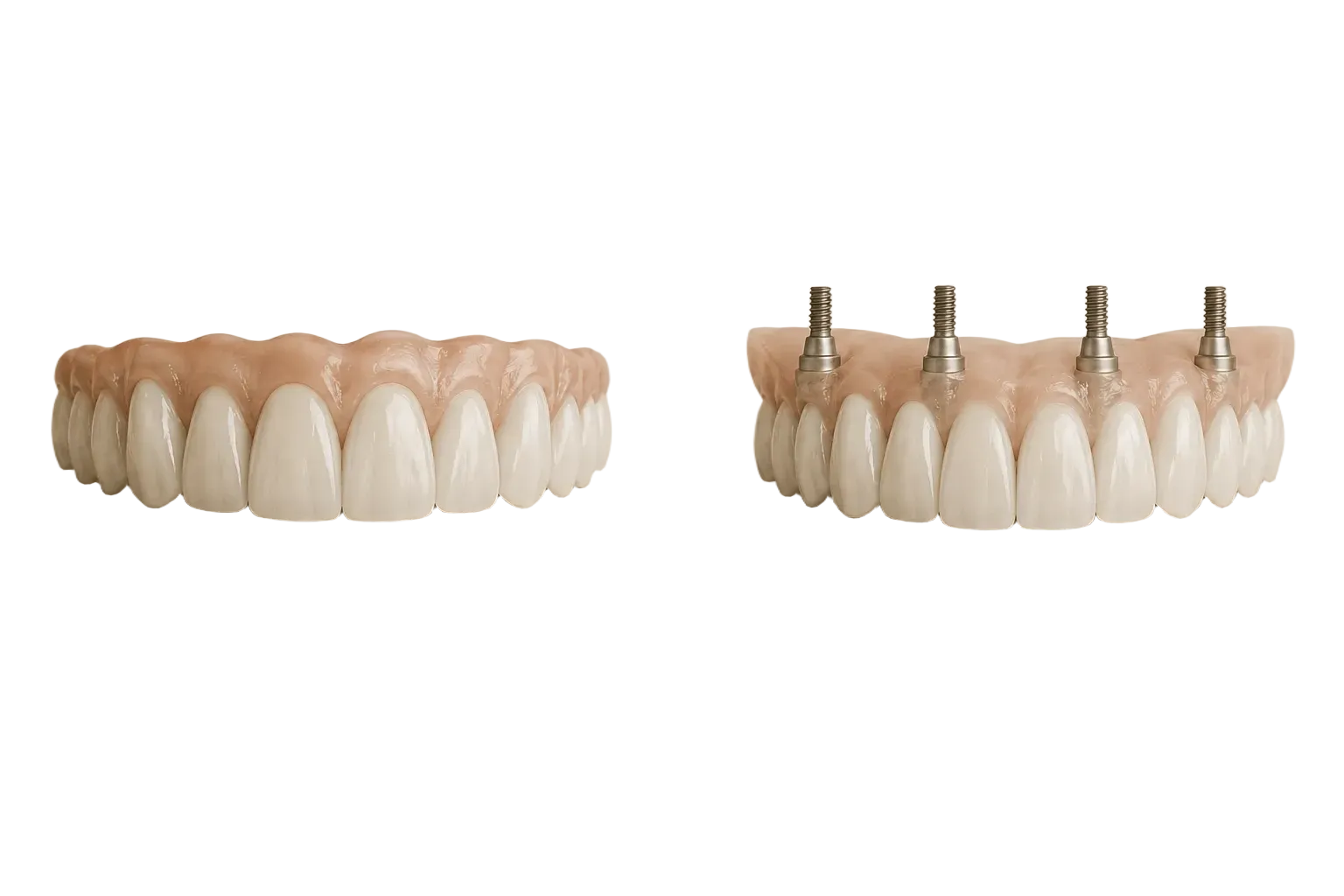
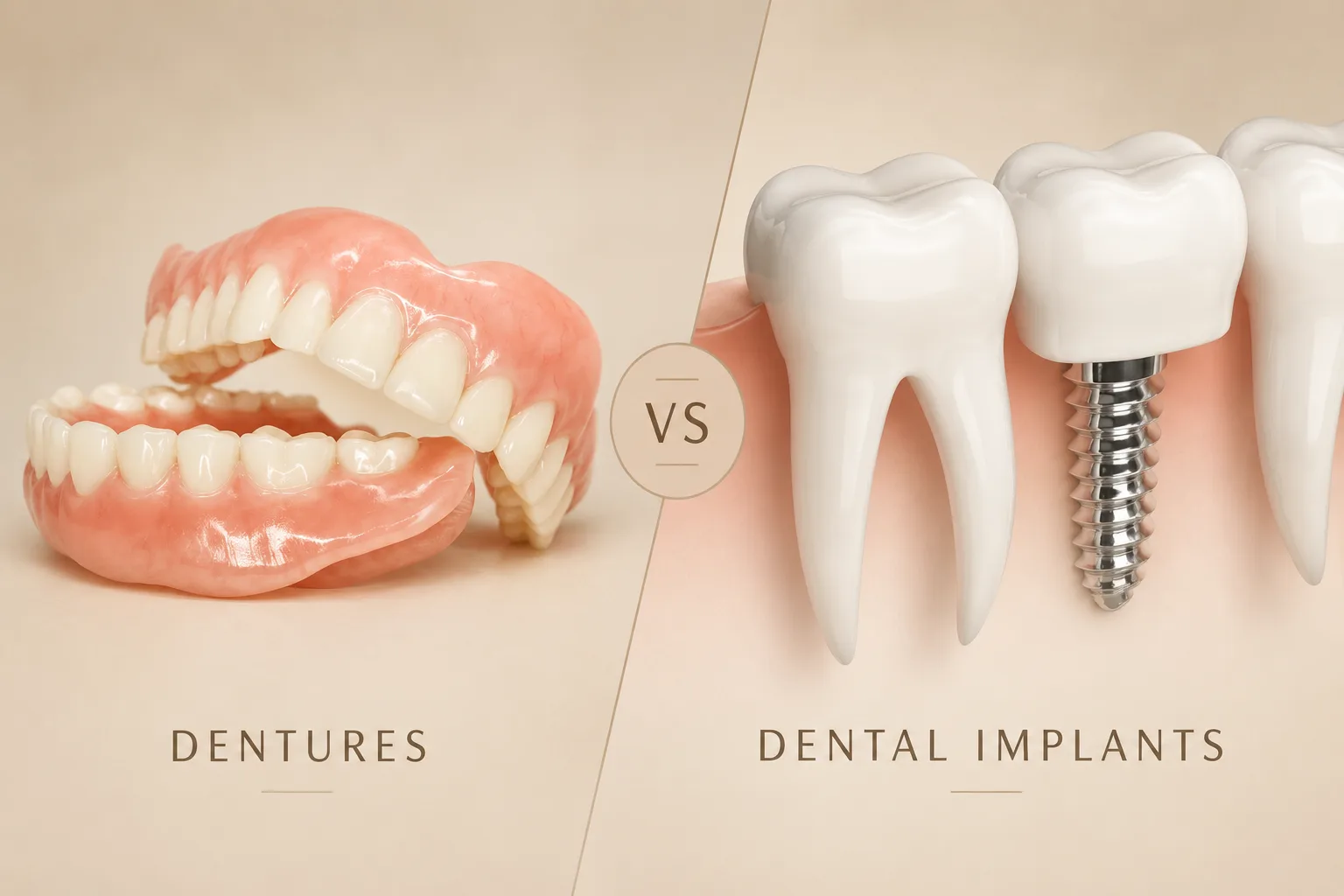
A fair, side by side look at both options what each one does, where each one falls short, and how to think through the decision for your specific situation.
Not every patient is a candidate for implants. This page does not assume you should choose one or the other.
Both replace missing teeth.
They work very differently.
A removable prosthesis that rests on the gums
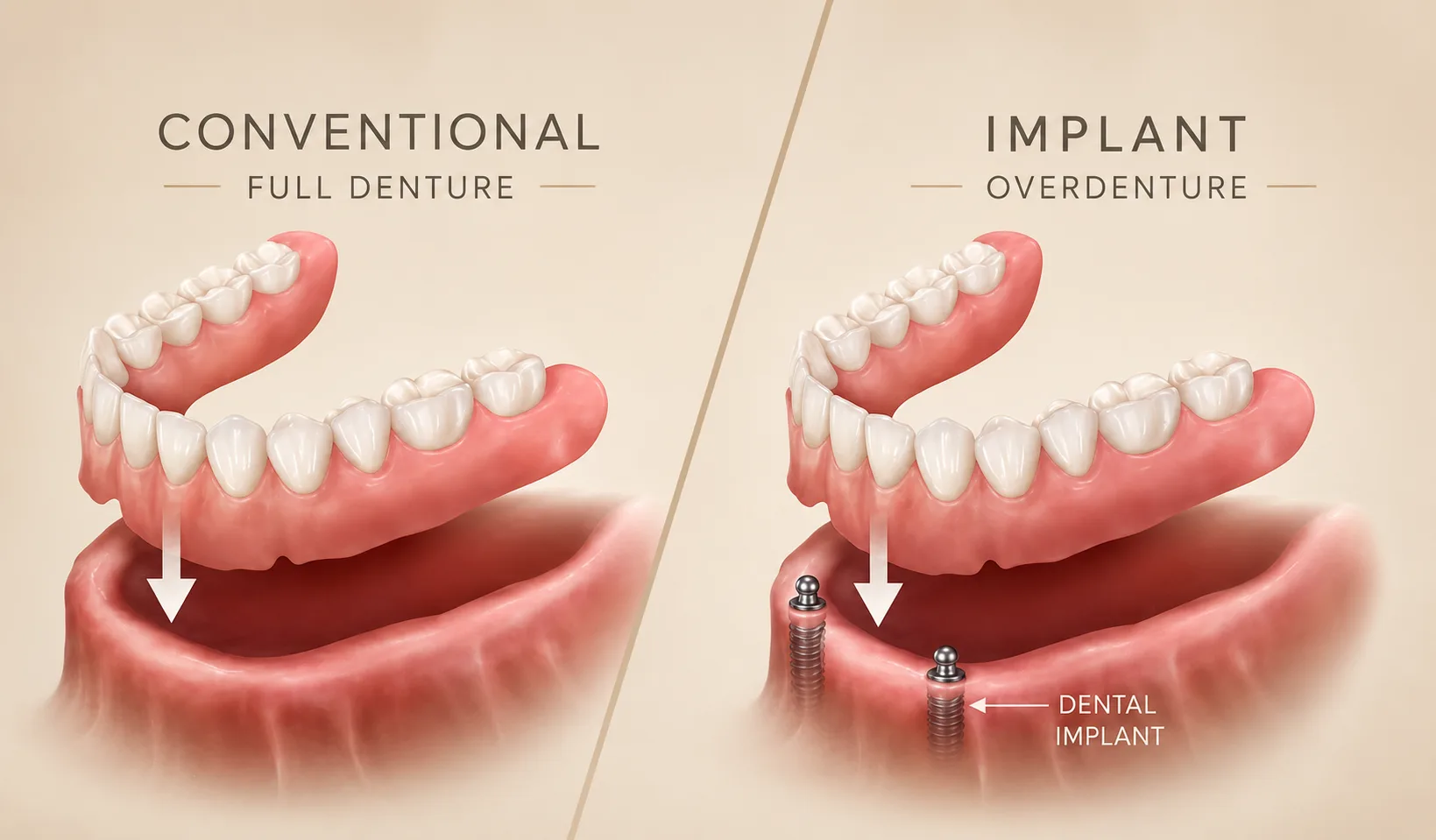
A denture is a removable appliance designed to replace a full arch of missing teeth. It sits on top of the gum tissue and is held in place by suction, clasps on remaining teeth (for partial dentures), or adhesive. Dentures are taken out for cleaning and typically at night.
Full dentures replace an entire arch. Partial dentures replace several missing teeth while the remaining natural teeth provide some support and retention.
Dentures have a lower initial cost than implants and can be fabricated more quickly. For patients who are not implant candidates, or who prefer a removable solution, they remain a valid option.
PRACTICAL LIMITATIONS
Fit degrades over time as bone shrinks
Chewing force significantly reduced
Movement during eating and speaking is common
Require daily removal and separate cleaning
A titanium root that anchors teeth permanently in the bone
A dental implant is a titanium post placed surgically into the jawbone, where it heals and integrates over several months. Once integrated, it supports a crown, bridge, or full arch prosthesis. The result is a fixed, permanent tooth or set of teeth that does not come out.
Implants can replace one tooth, several adjacent teeth, or a full arch. Because they are anchored in the bone, they stimulate the jaw the way natural roots do slowing or stopping the bone loss that occurs after tooth extraction.
The upfront cost is higher and the timeline is longer than dentures. Candidacy depends on bone volume, gum health, and general health.
PRACTICAL CONSIDERATIONS
Requires surgery and a multi-month healing period
Higher initial investment than dentures
Candidacy depends on bone and overall health
Not appropriate for every patient
Ten factors,
compared directly
Fixed or removable
Fixed, stays in the mouth permanently; not removed
Bone health over time
Implants stimulate bone at each placement site, slowing or stopping further loss
Chewing capacity
Substantially restored; most patients can return to a normal diet
Stability and fit
Stable; does not shift as bone changes because the implants are anchored in the jaw
Daily maintenance
Brushed and flossed like natural teeth; no removal, no adhesive
Effect on neighboring teeth
Self supporting; no force transferred to adjacent natural teeth
Facial appearance
Implants preserve bone and a well-designed prosthesis supports facial structure
Cost at the outset
Higher upfront investment; lower maintenance costs over time
Longevity
Designed for long term function with proper maintenance
Social and emotional comfort
Fixed teeth remove the daily concern about slippage, noise, or removal
Fixed or removable
Removable, taken out for cleaning and overnight
Bone health over time
The underlying bone continues to shrink after tooth loss; dentures do not address this
Chewing capacity
Limited; bite force is a fraction of natural teeth; many patients avoid hard or chewy foods
Stability and fit
Fit changes as the jawbone shrinks; relining or replacement needed over time
Daily maintenance
Must be removed, soaked, and cleaned separately; adhesives often needed
Effect on neighboring teeth
Partial dentures use clasps on remaining teeth, which can cause wear over time
Facial appearance
Bone loss under dentures can cause the face to look sunken over time
Cost at the outset
Lower initial cost; significant ongoing expenses for adjustments, relining, and eventual replacement
Longevity
Typically replaced every 5 to 10 years as fit degrades
Social and emotional comfort
Many patients report anxiety about fit and movement in social settings
Dentures are not an inferior choice in every situation
Patients who do not have enough bone remaining for implants, and who are not candidates for or do not want bone grafting.
Patients with health conditions that significantly increase the risk of implant surgery, including uncontrolled diabetes, blood-thinning medications, or immune conditions.
Patients for whom the cost of implants is not feasible, and for whom a removable prosthesis is the most practical path forward.
Patients who prefer a removable option and are comfortable with the maintenance routine.
Patients who need teeth replaced quickly and cannot commit to the multi-month implant timeline.
The long term case for implants is strongest in these situations
Patients with sufficient bone at the implant sites, or who are candidates for grafting to rebuild it.
Patients who are frustrated by loose, shifting, or unstable dentures and want a fixed result.
Patients concerned about continued bone loss and its effect on facial appearance over time.
Patients who want to restore normal chewing capacity and return to a full diet without restrictions.
Patients planning for the long term, for whom the higher upfront cost is offset by lower ongoing maintenance.
Implant supported
dentures explained
Implant supported dentures, including implant-retained snap-on dentures, sit on two to four implants that provide retention and stability. The denture still comes out for cleaning, but it snaps onto the implants instead of relying on suction or adhesive.
This option gives patients significantly better stability than a conventional denture at a lower cost and implant count than a fully fixed full arch implant solution. It is often the right middle ground for patients who want more stability than a conventional denture but are not ready for or do not qualify for fixed implants.
The implants used for an overdenture also stimulate bone at those sites, slowing loss even though the prosthesis is still removable.
When fixed implant
teeth are the goal
A fully fixed arch on implants, whether All-on-X, full arch implants, or a bridge on multiple implants, does not come out. It is maintained like natural teeth and provides bite force close to that of a natural dentition.
This is the highest-investment option and the most demanding in terms of bone requirements and treatment length. It is also the option that most closely replicates what natural teeth feel like, no movement, no adhesive, no appliance.
At Dental Implants & Cosmetics in Plantation, we evaluate all three options, conventional dentures, implant supported dentures, and fixed full arch implants, and explain which is realistic for your bone and health before any plan is proposed.
The right answer starts
with your evaluation
This page can help you understand the differences, but it cannot tell you which option is appropriate for your specific bone health, medical history, and goals.
A consultation at our Plantation practice includes 3D imaging, a clinical review, and an honest conversation about what is realistic, and what each path actually costs over time. We serve patients from across Broward County, including Fort Lauderdale, Davie, Weston, Sunrise, and Cooper City.
Dentures vs implants,
answered fairly



Your smile has a story.
Let's design
what comes next.
Begin with a private consultation designed to help you understand your options clearly and confidently with no pressure and no obligation.