
Crowns and Bridges
That Restore Strength and Confidence
Precision-fabricated restorations that repair damaged teeth or replace missing ones. Designed for fit, function, and a natural result that holds up over years.
When a crown or bridge
is recommended
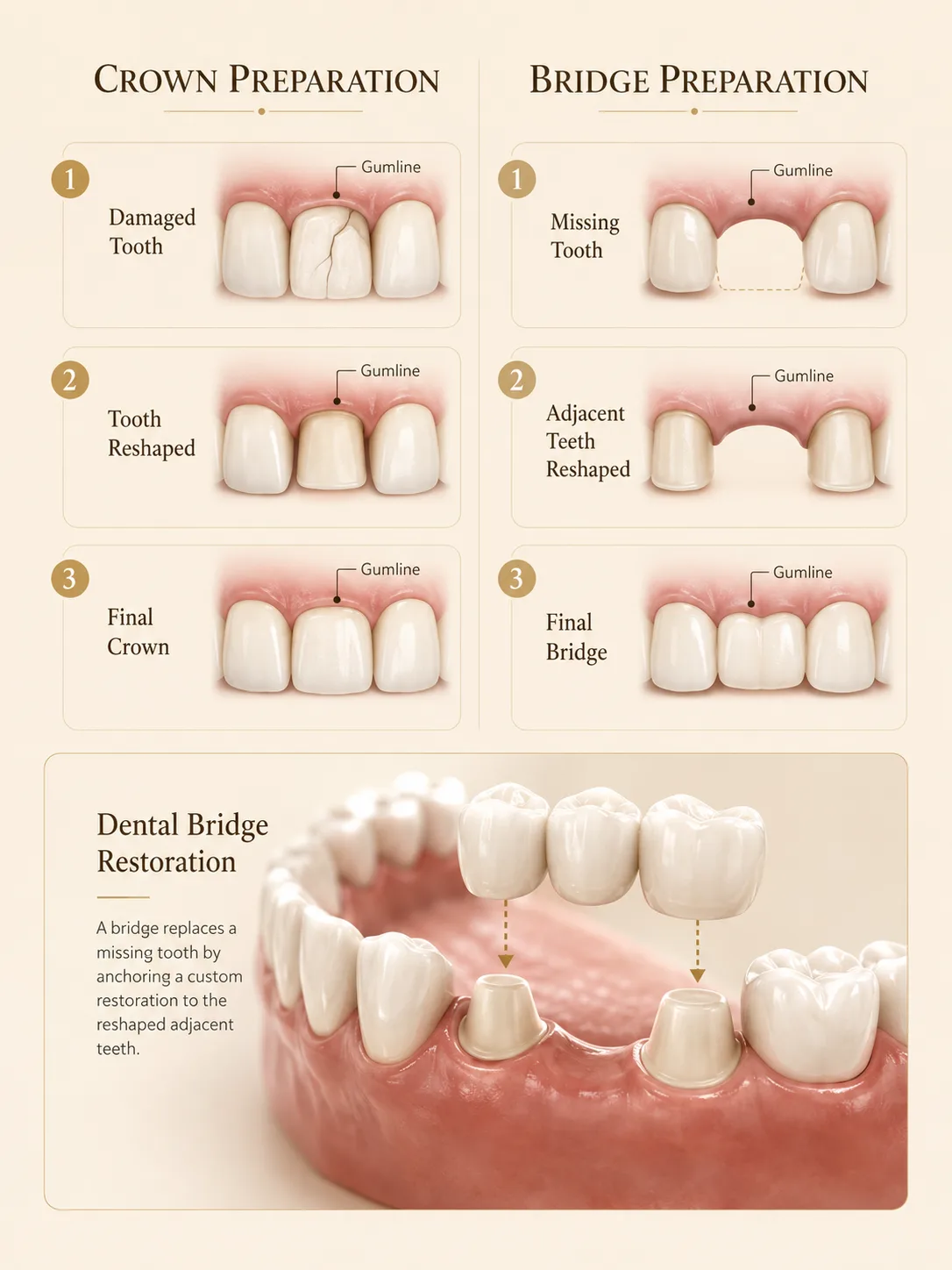
A crown and a bridge are related restorations that solve different problems. A crown is placed over a single tooth to protect or rebuild it. A bridge spans a gap created by one or more missing teeth.
What a crown is
A dental crown is a full coverage ceramic or zirconia restoration that fits precisely over a prepared natural tooth. It protects the remaining tooth structure from fracture, restores bite function, and, in the visible smile, blends seamlessly with adjacent teeth. Learn about porcelain crowns as one restoration option.
Fractured or cracked tooth
A crack that extends into the tooth structure weakens it and typically requires a crown to hold it together and prevent the fracture from propagating toward the root.
Large existing filling
When a filling occupies more than roughly 50% of a tooth's surface area, the remaining enamel is at risk of fracturing. A crown distributes bite forces across the entire tooth.
After root canal treatment
Root canal therapy removes the internal pulp and leaves the tooth more brittle. Most posterior teeth that receive root canal treatment require a crown to prevent fracture under normal function.
Severe decay that cannot support a filling
When decay has destroyed too much tooth structure for a direct restoration to be predictable, a crown rebuilds the entire visible tooth from a precision-fabricated shell.
What a bridge is
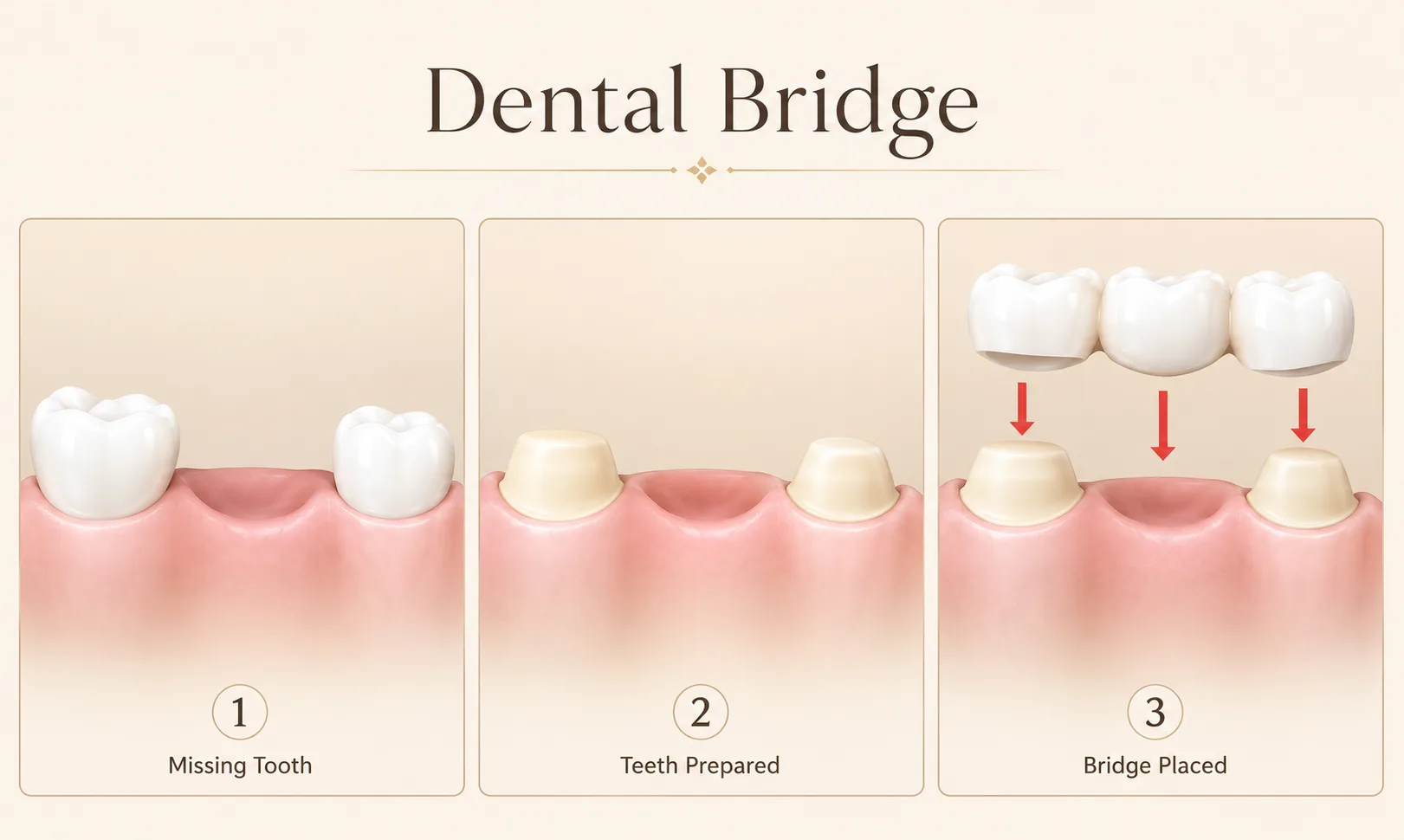
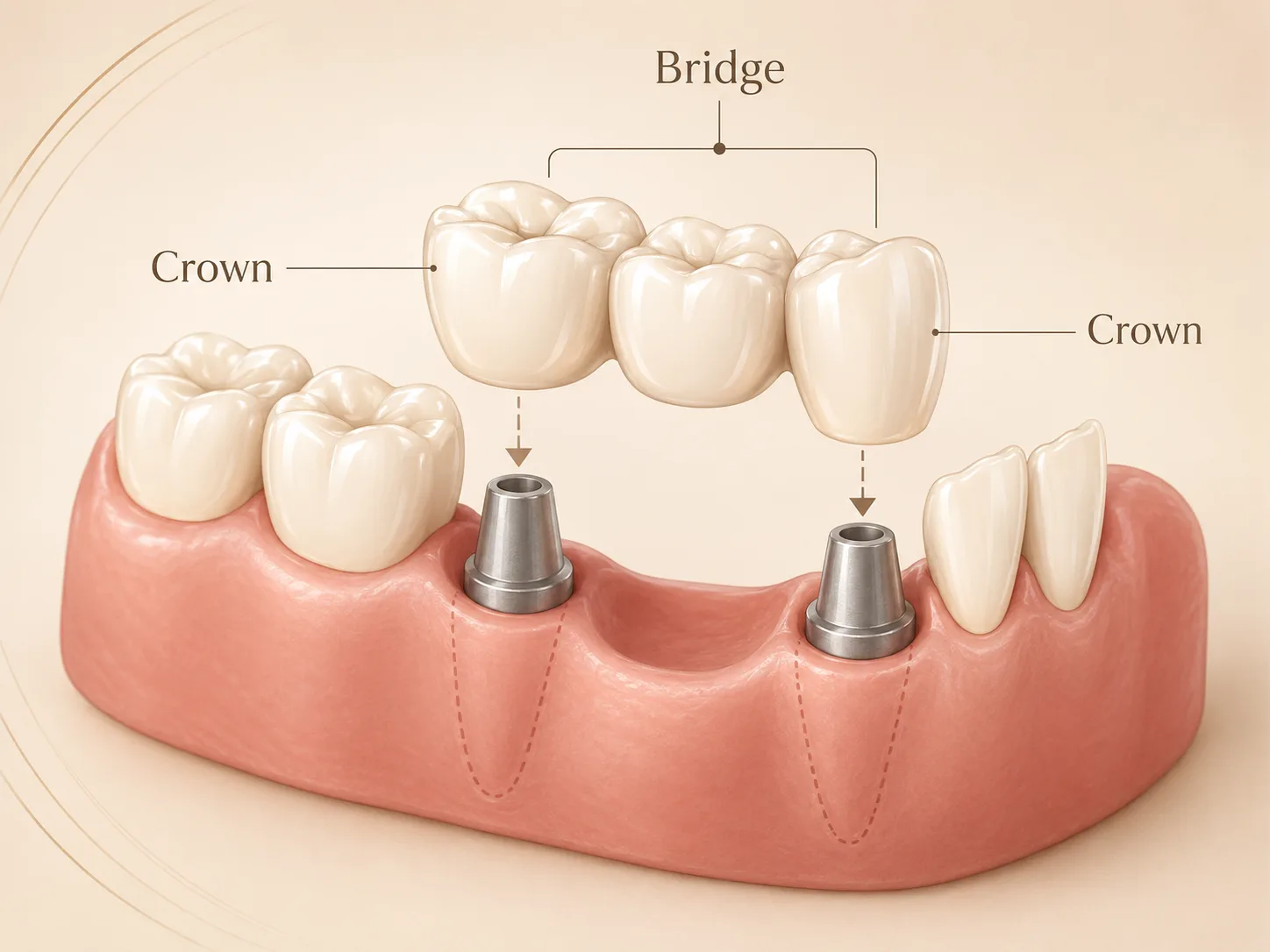
A dental bridge replaces one or more missing teeth by spanning the gap with an artificial tooth or teeth. The bridge is anchored to neighboring teeth or implants. It restores the appearance and function of the missing tooth while preventing the drift and bite changes that follow an unaddressed gap. Read more about porcelain bridges.
Traditional bridge
The missing tooth is replaced by an artificial tooth held in place by two crowns cemented onto the teeth on either side of the gap. The adjacent teeth are prepared to support the restoration. This is the most common type.
Implant supported bridge
Dental implants placed in the jawbone support the bridge rather than adjacent natural teeth. This eliminates the need to prepare healthy neighboring teeth and preserves bone at the site of the missing tooth. It is generally the more durable long term option.
Cantilever bridge
Used only in specific clinical situations where only one adjacent tooth is available for support. Less common than traditional bridges and limited to areas of lower bite force.
What to expect
from start to finish
Most crown and bridge cases are completed in two appointments. The first prepares the tooth and captures the precise fit; the second seats the final restoration.
Evaluation and planning
We examine the tooth or gap, take X-rays to evaluate the underlying bone and root condition, and discuss all available options including implants as an alternative to bridges. You leave this appointment with a clear understanding of what is recommended and why.
Preparation
For a crown, the tooth is reshaped to accommodate the ceramic shell. For a bridge, the abutment teeth are prepared in the same way. An impression or digital scan is taken of the prepared tooth and surrounding bite to guide fabrication.
Temporary restoration
A temporary crown or bridge is placed to protect the prepared teeth and maintain your bite and appearance while the final restoration is being fabricated. We cover what to expect and what to avoid during this interim period.
Final fit and cementation
At your second appointment, the final restoration is tried in, checked for fit, bite accuracy, and shade match, then permanently cemented. We make any final adjustments before you leave to ensure a comfortable, accurate result.
Care and longevity
Well-made crowns and bridges last 10 to 15 years or more with proper care. Consistent home care, routine cleanings, and addressing any bite concerns early are the most important factors in long term durability.
How bridges compare
with dental implants
For most patients replacing a single missing tooth, a dental implant is the stronger long term option. A bridge is valid when an implant is not appropriate. We explain the tradeoffs honestly so you can make the right decision for your situation.
| Factor | Bridge | Implant |
|---|---|---|
| Bone preservation | Does not preserve bone at missing tooth site | Stimulates bone and prevents resorption |
| Adjacent tooth impact | Requires reshaping healthy neighboring teeth | Does not affect neighboring teeth |
| Timeline | Typically 2 appointments over 2 to 3 weeks | Several months including healing |
| Longevity | 10 to 15 or more years with maintenance | 20 or more years with proper care |
| Best for | Patients who need a faster solution or are not implant candidates | Most patients missing one or more teeth |
Questions about crowns and bridges



Your smile has a story.
Let's design
what comes next.
Begin with a private consultation designed to help you understand your options clearly and confidently with no pressure and no obligation.